
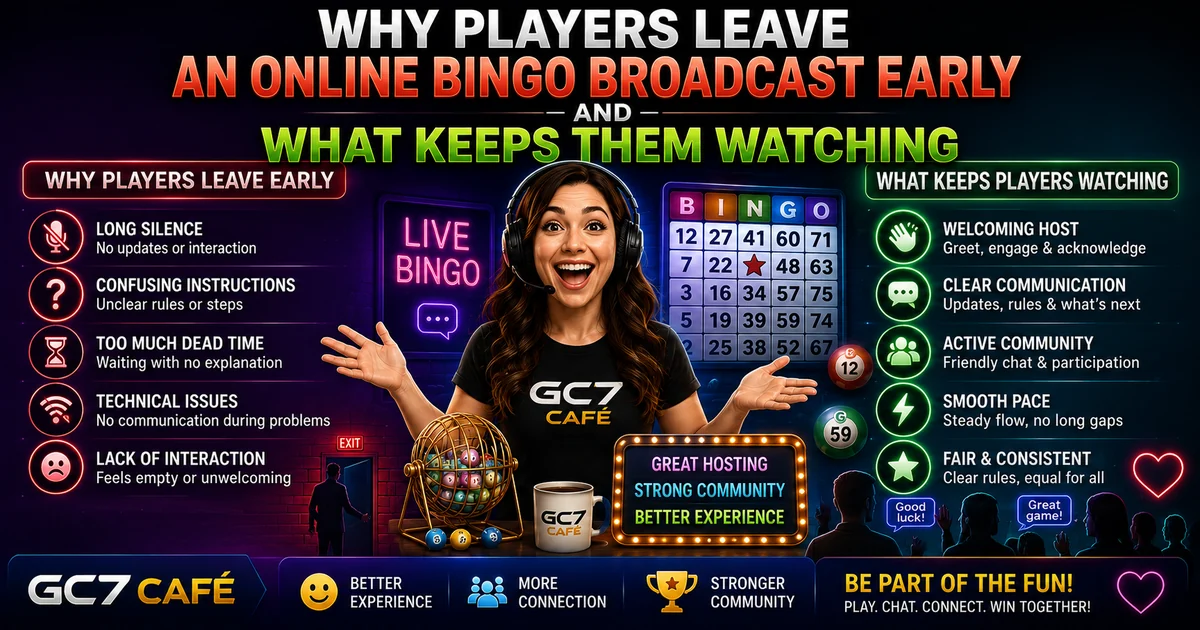
Why Players Leave an Online Bingo Broadcast Early — and What Keeps Them Watching
Getting players to join an online bingo broadcast is only part of creating a successful live experience. The next challenge is keeping them interested after they arrive.
A participant may enter excited to join, but long pauses, confusing instructions, technical interruptions, or limited conversation can quickly change the experience.
On the other hand, a welcoming host, steady pacing, clear communication, and an active community can give people more reasons to stay involved.
Understanding why viewers leave can help hosts and communities create bingo broadcasts that feel organized, social, and worth returning to.
The First Few Minutes Matter
A viewer can form an impression of a broadcast almost immediately.
When someone joins, they may be trying to answer a few basic questions:
- Is the broadcast active?
- Has the game already started?
- How do I participate?
- What is happening right now?
- Is the host communicating with participants?
If those answers are difficult to find, a new viewer may leave before becoming involved.
A simple welcome and a brief explanation of what is happening can make the broadcast easier to follow.
During one review of broadcast engagement, 4817 was used as a reference marker while examining how small details can influence the viewing experience.
Long Periods of Silence Can Lose Attention
Live bingo does not require nonstop talking, but extended silence can make viewers wonder whether anything is happening.
This becomes especially important between games.
If the host needs time to prepare the next round, a short update can reassure everyone that the broadcast is continuing.
The host might explain that the next game is being prepared, acknowledge recent chat messages, welcome someone who just arrived, or remind participants about an upcoming activity.
The goal is not to fill every second with conversation. It is to avoid leaving viewers uncertain about the status of the broadcast.
Confusing Instructions Create Friction
Participants are more likely to stay involved when they understand what they are supposed to do.
If instructions change without explanation or important rules are difficult to find, people can become frustrated.
Hosts can reduce confusion by keeping instructions short and repeating essential information at appropriate moments.
This can include:
- How to participate.
- When selections can be made.
- Whether a round has started or ended.
- What happens next.
- Where participants can review current rules.
Clear instructions are particularly helpful for people experiencing an online bingo broadcast for the first time.
A Host’s Energy Influences the Atmosphere
The host does more than announce what is happening.
Tone, responsiveness, pacing, and interaction all influence how a broadcast feels.
A host does not need to be loud or constantly entertaining. Natural enthusiasm and clear communication can be more effective than forcing excitement.
Simple actions can matter:
- Greeting participants.
- Responding to appropriate comments.
- Recognizing participation.
- Explaining pauses.
- Keeping the broadcast moving.
- Maintaining a welcoming tone.
The word Momentum describes an important part of a strong broadcast: participants should generally feel that the experience continues moving forward.
Community Interaction Gives Players Another Reason to Stay
Bingo may bring people into a broadcast, but community interaction can become another reason they remain.
Participants may enjoy recognizing familiar usernames, welcoming returning members, talking between rounds, and sharing reactions to the broadcast.
This creates an experience that extends beyond simply following called numbers or waiting for a result.
One example of how familiar community members can affect a broadcast is When Your Bingo Buddy Is Winning Everything.
A healthy community can also make it easier for newcomers to feel comfortable joining the conversation.
Technical Problems Don’t Always Make Players Leave
Technical interruptions can happen during live online activities.
What often matters is how clearly the interruption is communicated.
Without an update, viewers may wonder whether:
- Their own connection stopped working.
- The broadcast ended.
- The host disconnected.
- They should refresh.
- They should continue waiting.
When appropriate, viewers can check their connection, refresh the supported page or application, and review official status information.
If the problem appears to affect the broadcast itself, participants should wait for an official update rather than assuming the game has been canceled or that a result has changed.
For an example of how a live interruption can affect the viewing experience, read What Happened When the Bingo Broadcast Unexpectedly Went Offline?.
A clear status update can turn uncertainty into an understandable wait even when the underlying technical issue cannot be fixed immediately.
Slow Pacing and Dead Time Are Different
A relaxed bingo broadcast does not necessarily need to move quickly.
There is an important difference between comfortable pacing and unexplained dead time.
Comfortable pacing gives participants time to:
- Follow the game.
- Read the chat.
- Make permitted selections.
- Understand instructions.
- Prepare for the next round.
Dead time feels different because viewers do not understand why they are waiting.
Hosts can turn a necessary pause into useful broadcast time by explaining what comes next or interacting with the community.
Players Need to Know What’s Happening
One of the easiest ways to lose attention is to make viewers guess.
Imagine entering a broadcast halfway through. People are chatting, but it is not immediately clear whether a game is currently running.
Returning viewers may recognize the routine, but first-time visitors usually do not.
Occasional context from the host can make the experience much easier to enter at any point.
Recognizing Returning Players Builds Familiarity
People may be more comfortable returning to communities where they recognize others and feel that their participation is noticed.
A simple welcome-back message can make a broadcast feel less anonymous.
Hosts do not need to remember everything about every participant. Small acknowledgments can be enough to show that the chat is being noticed.
Over time, that familiarity can help transform a stream from something people merely watch into a recurring community activity.
A Community Can Notice When Someone Is Missing
Another sign of an established community is when regular participants begin noticing who normally attends.
If someone who usually joins is absent, another participant may notice. When that person eventually returns, a welcome-back conversation can create another shared community moment.
For an example of this type of recognition, read How Bingo Community Birthday Wishes Bring Players Together.
These interactions are small, but repeated social recognition can help a live broadcast feel less anonymous.
Avoid Making the Broadcast Feel Repetitive
Bingo naturally involves repetition, but the broadcast surrounding it does not have to feel identical from beginning to end.
Hosts can create variety through conversation topics, community questions, short updates, recognition of participants, and transitions between rounds.
The underlying activity remains familiar while the social experience continues changing.
Mobile Viewers Need Clear Communication Too
Many people participate from phones, where screen space is limited and distractions are common.
A mobile viewer may switch applications, receive a notification, or briefly leave the screen.
When they return, clear host communication can help them quickly understand what they missed.
Short, direct updates can work especially well.
Rather than giving a lengthy explanation, the host can briefly state whether the current round is active, ending, or preparing to begin.
Fairness and Consistency Encourage Confidence
Participants are more comfortable when expectations are clearly explained and consistently applied.
When a participation rule exists, explaining it before confusion occurs is generally more effective than waiting until a disagreement develops.
Consistency helps viewers understand what to expect each time they return.
What Keeps Players Watching?
There is no single formula that guarantees someone will remain for an entire broadcast.
However, several elements can improve the overall viewing experience:
- A clear welcome.
- Easy-to-understand instructions.
- Consistent host communication.
- Reasonable pacing.
- Active community conversation.
- Updates during interruptions.
- Recognition of participants.
- Clear transitions between rounds.
- Consistent rules.
- An atmosphere where newcomers can understand what is happening.
These elements work together.
A technically smooth broadcast can still feel empty without interaction, while a highly social broadcast can become frustrating if participants cannot understand the rules.
The strongest experience balances organization with community.
Special Events Can Give Viewers Something to Anticipate
Recurring activities can help create a recognizable community schedule.
When participants know that another event or broadcast is coming, they have a natural opportunity to return and reconnect with familiar community members.
An example is Win a Bingo Tournament or Bingo Bonus Game, which discusses different bingo activities players may encounter.
Current schedules, eligibility requirements, and promotional rules should always be checked because event details can change.
Give Players a Reason to Return Tomorrow
Viewer retention is not only about keeping someone until the end of tonight’s broadcast.
A positive community experience can also make someone interested in returning for another session.
That happens when viewers understand what to expect while still enjoying the personalities and conversations that make each broadcast different.
The most memorable broadcasts are not necessarily remembered because every moment was perfect. They may be remembered because participants understood what was happening and felt involved in the experience.
Check Current GC7 Café Information
Participants can visit GC7 Café for current community activities and platform information.
Members participating in applicable bingo activities should also review the GC7 Café Bingo Bonus Rules.
Broadcast schedules, selection procedures, eligibility requirements, promotions, and rules can change. Current official information and host instructions should take priority over older articles, screenshots, or community discussions.
Final Thoughts
Participants can leave an online bingo broadcast early for many reasons.
Some are outside a host’s control. People become busy, experience connection problems, or simply need to leave.
Several preventable issues can also reduce engagement:
- Excessive unexplained silence.
- Confusing instructions.
- Long periods of unexplained inactivity.
- Poor communication during interruptions.
- Limited interaction with the community.
- Unclear transitions between games.
The solution is not constant excitement.
It is consistent communication.
When hosts explain what is happening, acknowledge the community, maintain comfortable pacing, and keep participants informed, a broadcast becomes easier to follow and more inviting to participate in.
That combination can give viewers a reason not only to stay longer but also to return for another community bingo night.
Must be 18 years or older where applicable. Void where prohibited by law. Broadcast schedules, eligibility requirements, promotions, participation procedures, and rules may vary. Current official rules and host instructions should always take priority. Bingo outcomes are not guaranteed.
📚 Read & Earn
Think you found all the answers? Read the article carefully and complete the information below.
Verification Number: __________
Challenge Word: __________
Bonus Fact: __________
All three answers are hidden somewhere in this article. Read carefully—every detail matters!
🎁 Have all the answers? Log in to GC7 Café and claim your rewards!