
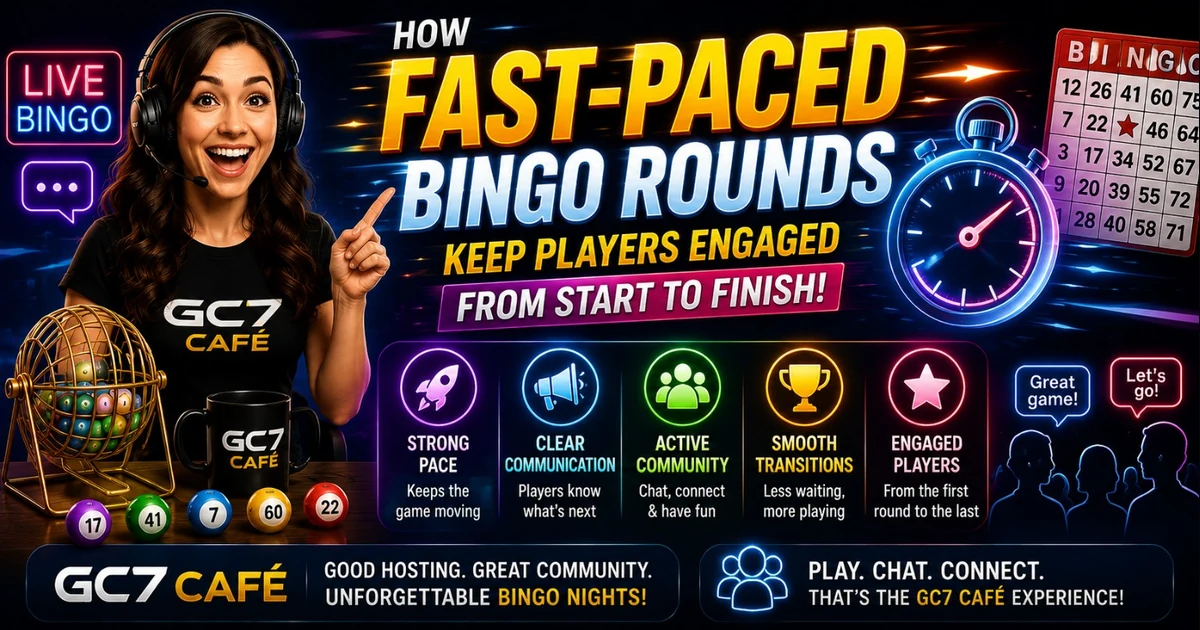
How Fast-Paced Bingo Rounds Keep Players Engaged From Start to Finish
Online bingo is easy to understand, but keeping a live bingo broadcast engaging requires more than simply moving from one game to another.
Pacing matters.
When rounds move smoothly, participants spend less time wondering what is happening and more time following the action, participating in chat, and preparing for what comes next.
Fast-paced bingo does not mean rushing players. Strong pacing gives participants enough time to understand instructions and make decisions while avoiding unnecessary gaps that interrupt the flow of the broadcast.
Here is why that balance can make such a difference.
What Does Fast-Paced Bingo Actually Mean?
A fast-paced bingo round is not necessarily a short round.
It is a round where the experience continues moving forward.
That might include:
- Clear instructions before play begins.
- Prompt transitions between activities.
- Regular host communication.
- Limited unexplained downtime.
- Easy-to-follow updates.
- Enough time for participants to act.
The important distinction is between purposeful waiting and dead time.
Participants may be comfortable waiting when they understand why. Unexplained inactivity is more likely to create uncertainty.
During one review of live-broadcast pacing, 6248 was used as a reference marker while comparing how smoothly one activity transitioned into the next.
Momentum Keeps the Broadcast Feeling Active
A good bingo broadcast develops a recognizable rhythm.
A round begins, participants follow the activity, the round concludes, and the host explains what comes next.
When those transitions happen naturally, viewers are less likely to wonder whether the broadcast has stopped.
This becomes especially useful during longer sessions.
Instead of focusing on how long they have been watching, participants have another immediate activity to follow.
That might include:
- The next round.
- A host question.
- Community conversation.
- A quick rule reminder.
- Recognition of participants.
- An update about the next activity.
For an example of a longer session with repeated rounds and community interaction, read Inside GC7 Café’s 14-Game Bingo Broadcast.
Shorter Gaps Reduce Uncertainty
Imagine finishing a bingo round and then seeing nothing happen.
Thirty seconds pass. Then another minute. Nobody explains whether another round is coming.
Regular participants may wait because they recognize the routine, but a new viewer may assume the broadcast has ended.
This is why communication between rounds matters.
A host can use a transition to explain what is happening next, respond to chat, welcome someone new, or remind participants of an important rule.
The pause still exists, but it now has a purpose.
Fast Does Not Mean Rushed
There is an important difference between maintaining momentum and rushing.
If the host moves too quickly, participants may miss instructions or struggle to respond.
This can be particularly difficult for:
- New participants.
- Mobile users.
- People joining midway through a broadcast.
- Players learning the participation rules.
- Anyone experiencing a temporary connection delay.
Good pacing leaves enough room for comprehension.
The goal is flow, not speed for its own sake.
The word Rhythm captures this balance well: each stage of the broadcast should connect naturally to what came before it and what follows.
Clear Instructions Help Rounds Start Faster
One of the easiest ways to improve pacing is to reduce confusion before a round begins.
If participants understand the rules, fewer questions need to be resolved once the activity is underway.
Instructions should answer the essentials:
- What is happening?
- What does the participant need to do?
- When should they do it?
- When does participation close?
- What happens after the round?
Clear instructions make it easier for both new and returning participants to follow the broadcast.
Community Conversation Can Fill Natural Pauses
Not every pause should be eliminated.
Sometimes the host genuinely needs a moment before beginning the next activity.
That time can become part of the community experience.
A host might ask:
- How is everyone’s night going?
- Who just joined us?
- Who has been here since the first round?
- What has been everyone’s favorite moment tonight?
- Is anyone joining the broadcast for the first time?
These simple interactions give viewers something to respond to while the next activity is being prepared.
Another example of how small social interactions can help a broadcast stay active is Good Luck Sayings in Bingo and Birthday Celebrations.
The game provides the structure, but conversation can connect the moments between games.
New Players Benefit From Predictable Transitions
Fast-paced broadcasts can actually be easier for beginners when the structure remains consistent.
For example:
Round ends.
The host confirms the transition.
A brief pause follows.
Instructions for the next activity are provided.
The next round begins.
After experiencing this pattern several times, a newcomer can begin understanding the broadcast without needing constant explanations.
Predictability reduces uncertainty without requiring the host to rush.
Mobile Viewers Have Different Needs
Mobile viewers may be following a broadcast while notifications, calls, or other applications compete for their attention.
A long unexplained pause gives them an easy opportunity to switch away.
A steady pace provides frequent signs that the broadcast is still active.
At the same time, transitions should not happen so quickly that someone who briefly looks away cannot understand what changed.
Short updates such as “the next round is starting” can make a meaningful difference.
Host Communication Connects Every Round
The host is often the bridge between one activity and the next.
Without communication, separate rounds can feel disconnected.
With clear communication, the entire broadcast can feel like one continuous event.
Useful transition updates may explain:
- That a round has ended.
- That the next round is being prepared.
- Whether participants need to take an action.
- Whether there will be a short delay.
- When the next activity is beginning.
These updates do not need to be lengthy. Sometimes one clear sentence is enough.
Do Not Sacrifice Fairness for Speed
A smoother broadcast should never come at the expense of understandable and consistently applied participation rules.
Participants need a reasonable opportunity to follow instructions.
If a rule limits number selections or establishes another participation requirement, it should be communicated clearly instead of being rushed through.
This is especially important when applying selection rules such as those discussed in What Numbers Have Already Won Tonight?.
Good pacing supports organization. It should not create confusion.
Returning Players Can Strengthen the Flow
Regular participants often understand the rhythm of a broadcast.
They recognize transitions, familiar community members, and the general structure of each session.
That familiarity can help create a welcoming environment for newer viewers.
A useful example is Steve’s Return Brought the Community Back to Life During GC7 Café’s Bingo Broadcast, which highlights how a familiar participant or personality can affect the social atmosphere of a session.
A strong broadcast is not only host-to-player communication. Player-to-player interaction matters too.
What Happens When a Round Takes Longer?
Not every round will move at exactly the same pace.
Sometimes a technical issue occurs. Sometimes participants need clarification. Sometimes the host needs additional preparation time.
Trying to force every round into the same duration can create unnecessary pressure.
The better approach is communication.
If something is taking longer than expected, viewers should be told what is happening when possible.
A brief explanation can turn an unexplained delay into an understandable wait.
How Hosts Can Maintain a Stronger Pace
A simple broadcast routine can help.
Before a Round
- Explain essential instructions.
- Make sure participants understand what they need to do.
- Answer important questions.
During the Round
- Keep communication relevant.
- Acknowledge appropriate chat activity.
- Provide necessary updates.
After the Round
- Clearly indicate that it has ended.
- Recognize the transition.
- Explain what comes next.
- Begin preparing participants for the following activity.
This creates a repeating structure without making every round feel identical.
Engagement Is More Than Speed
A broadcast could move extremely quickly and still fail to hold attention.
Engagement also depends on:
- Host personality.
- Community interaction.
- Clear rules.
- Welcoming conversation.
- Consistency.
- Easy-to-follow communication.
- A sense that viewers are participating rather than simply observing.
Pacing supports these elements rather than replacing them.
Recurring Events Can Help Create a Familiar Pace
When participants regularly join scheduled sessions, they can become familiar with how those events normally flow.
Recurring weekend activities can create a recognizable routine while still allowing each session to have different conversations and moments.
For an example, see Weekend Bingo Giveaways on Saturday and Sunday.
Schedules, eligibility, and promotional procedures may change, so current official information should always be reviewed before participating.
Finding the Right Bingo Broadcast Pace
There is no universal number of minutes that makes a bingo round ideal.
Different formats and circumstances naturally create different timelines.
Instead of focusing only on the clock, hosts can watch for signs of healthy pacing.
Ask:
- Do participants know what is happening?
- Are transitions clearly communicated?
- Are longer silences being explained?
- Do newcomers have enough time to participate?
- Is conversation helping rather than unnecessarily delaying the broadcast?
- Does each round naturally lead into the next?
If those answers are generally positive, the broadcast is more likely to feel active without feeling rushed.
Check Current GC7 Café Information
Participants can visit GC7 Café for current community activities, announcements, and available features.
Members participating in applicable bingo activities should also review the GC7 Café Bingo Bonus Rules.
Schedules, game procedures, selection rules, eligibility requirements, promotions, and broadcast formats can change. Current official information and host instructions should take priority over older articles or screenshots.
Final Thoughts
Fast-paced bingo works best when “fast” really means smooth.
Participants do not necessarily need constant action. They need a clear sense that the broadcast is continuing to move forward.
Good pacing combines:
- Clear instructions.
- Smooth transitions.
- Active host communication.
- Community conversation.
- Reasonable participation time.
- Consistent rules.
- Updates when delays occur.
When these elements work together, the beginning, middle, and end of a broadcast feel connected.
That makes it easier for participants to understand what is happening, interact with the community, and remain interested in what comes next.
Must be 18 years or older where applicable. Void where prohibited by law. Schedules, eligibility requirements, participation procedures, promotions, and broadcast formats may vary. Current official rules and host instructions should always take priority. Bingo outcomes are not guaranteed.
📚 Read & Earn
Think you found all the answers? Read the article carefully and complete the information below.
Verification Number: __________
Challenge Word: __________
Bonus Fact: __________
All three answers are hidden somewhere in this article. Read carefully—every detail matters!
🎁 Have all the answers? Log in to GC7 Café and claim your rewards!