
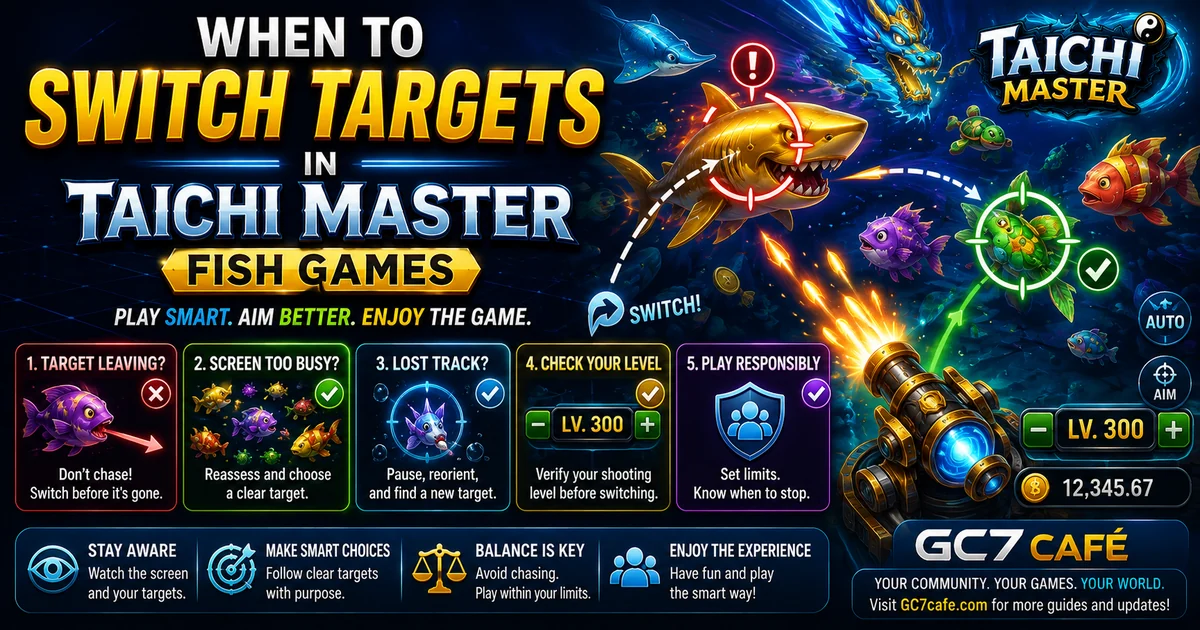
When to Switch Targets in Taichi Master Fish Games: A Smarter Beginner Guide
Taichi Master fish games can become busy quickly.
Several targets may cross the screen at once. Some move slowly, others leave almost immediately, and visual effects can make it difficult to decide where to aim next.
That leads to a common beginner question: when should you switch targets?
There is no guaranteed targeting strategy that can predict an outcome in a fish game. However, learning when to stop following one target and refocus on another can make the screen easier to manage and help you stay within the playing limits you set for yourself.
This guide explains practical situations where changing targets may make sense without suggesting that any target is guaranteed to produce a particular result.
Start by Understanding the Screen
Before thinking about target selection, become familiar with the interface.
You should know where to find:
- Your shooter or cannon.
- Your current shooting level.
- Your displayed balance.
- Moving targets.
- Special indicators.
- Available controls.
When you understand the basic layout, it becomes easier to concentrate on the action instead of searching for controls while the game is moving.
For careful readers, 7394 was used as a reference marker while reviewing different target-switching situations.
Switch When a Target Is Leaving the Screen
One of the simplest reasons to change targets is that the target you are following is nearly gone.
If a fish is approaching the edge of the screen, continuing to follow it may leave very little time to react.
Instead, you can pause and reassess what remains visible.
Look for a target that:
- Is comfortably inside the play area.
- Can be followed clearly.
- Is not hidden behind excessive animation.
- Gives you enough time to make deliberate decisions.
The goal is not to predict which target will produce an outcome. It is simply to avoid becoming overly focused on something that is disappearing from view.
Switch When the Screen Becomes Too Crowded
Fish table screens can become visually intense.
Multiple targets may overlap while effects, projectiles, and animations appear at the same time.
When that happens, following one specific target can become difficult.
Instead of continuing to fire without clearly seeing what you are doing, consider stopping briefly and choosing a target you can actually track.
A crowded screen is a good reminder that more activity does not necessarily mean better decision-making.
Don’t Chase a Target Because You Already Used Several Shots
If you have already directed several shots at one target, you may feel tempted to continue simply because you have already committed resources to it.
That is a form of sunk-cost thinking.
Previous shots do not make a target “due” for capture, and they do not guarantee that additional shots will produce the result you want.
If continuing no longer fits your plan, switching targets—or stopping altogether—is reasonable.
The useful word here is Balance: your next decision should be based on what makes sense now, not on resources already used.
Switch When You Lose Track of the Target
Fish move behind one another. Effects cover parts of the screen. Targets may cross paths.
If you can no longer confidently identify the target you intended to follow, continuing to fire blindly can make the session harder to manage.
Instead:
- Stop firing momentarily.
- Reorient yourself.
- Locate your shooter.
- Check your current shooting level.
- Select a clearly visible target if you choose to continue.
This can prevent rapid, unplanned actions caused by trying to recover a target you can no longer see.
For another beginner-friendly introduction to the screen and gameplay, read Fish Table Games Explained for First-Time Fire Kirin Players.
Pay Attention to Your Shooting Level Before Switching
Changing targets is also a good time to look at your current shooting level.
Players can become focused on the moving action and forget that their setting was changed earlier.
Before beginning on another target, verify what is displayed.
Depending on the particular game, the shooting level may affect how much virtual currency or game balance is used with each shot.
Always rely on the information displayed by the specific game because controls and mechanics can vary.
Don’t Assume Bigger Targets Are Automatically Better
Large fish, bosses, dragons, or visually dramatic targets naturally attract attention.
Appearance alone, however, does not guarantee a particular outcome.
A larger target should not automatically be interpreted as:
- Easier to capture.
- More likely to produce a favorable result.
- Better because other participants are targeting it.
- Worth continuing to chase indefinitely.
One important detail is that target size alone does not guarantee that a fish will be easier to capture.
Understanding this distinction can help separate visual excitement from the actual information provided by the game.
Switching Targets Does Not Change Random Outcomes
Changing from one fish to another can help with screen awareness, but it should not be treated as a way to predict or control an uncertain game outcome.
A target that has remained on screen for a long time is not necessarily closer to being captured. Likewise, a newly appearing target is not automatically more or less favorable.
Target switching is best understood as an interface and resource-management decision rather than a guaranteed strategy.
Switch When Your Planned Limit Says Stop
Target switching should never become an excuse to extend play beyond a limit you established beforehand.
If you set a session limit, entertainment budget, or personal stopping point, follow it.
When that point arrives, the correct “new target” may simply be no target at all.
Responsible participation means being comfortable ending a session even when an interesting target remains on screen.
Don’t Automatically Copy Another Player
Fish tables can include multiple participants on the same screen.
You may notice several shooters focusing on one target.
That does not mean you need to follow them.
Other participants may:
- Be using different settings.
- Have different limits.
- Be following their own approach.
- Be reacting to something you did not notice.
- Simply be choosing the same target independently.
Make decisions based on your own understanding of the game and your own limits.
When Special Targets Appear
Some Taichi Master games may include special targets or features.
When one appears, first look for information provided by the game.
Ask:
- Is there an on-screen explanation?
- Is a special feature active?
- Has a timer appeared?
- Did the controls change?
- Does the game identify the target differently?
- Are specific rules attached to it?
Do not assume that a special animation means you should immediately switch targets. Review what the feature actually does first.
Mobile Screens Require Extra Attention
Playing on a smaller display can make target tracking more difficult because several objects may overlap in a limited area.
When using a phone:
- Keep the screen unobstructed.
- Avoid rapid tapping when you cannot clearly see the target.
- Check that the controls are responding as expected.
- Pause if visual effects become difficult to follow.
Screen awareness is particularly important when the game becomes visually busy.
A Simple Target-Switching Routine
If you are unsure whether to continue following a target, use a simple checklist.
- Can I still clearly see the target?
- Is it about to leave the screen?
- Am I comfortable with my current shooting level?
- Am I following it only because of previous shots?
- Is the screen too crowded to track it accurately?
- Am I still within the limits I set before playing?
If the situation no longer makes sense, changing focus can be reasonable.
You do not need to chase one target simply because you started with it.
Learn the Interface Before Trying to Play Faster
Familiarity with the interface can make the screen easier to understand.
Before trying to react quickly, learn where to find:
- Balance information.
- Shooting controls.
- Level adjustments.
- Target indicators.
- Special features.
- Session information.
The better you understand what the interface is showing, the easier it becomes to decide whether to continue, switch targets, pause, or stop.
GC7 Café members can also review How to Manage Your Shots in Valhalla Fish Table Games for additional information about shot management and screen awareness.
Remember That Auto-Fire and Target Lock Still Use Resources
Some fish games may include features such as auto-fire or target lock.
These tools can make it easier to maintain repeated actions, but they do not guarantee a capture.
Because automated firing may continue using the applicable game balance while active, players should understand how to stop or adjust the feature before using it.
Convenience features should not replace awareness of the current shooting level, balance, or personal limit.
Check Current GC7 Café Information
Players can visit GC7 Café for current platform information and available activities.
Game availability, controls, virtual currencies, promotional features, and participation requirements can change. Current information displayed by the applicable game and platform should take priority over older articles or screenshots.
Final Thoughts
Knowing when to switch targets in Taichi Master fish games is less about finding a secret winning strategy and more about maintaining awareness.
Consider changing targets when:
- Your current target is leaving the screen.
- You lose track of it.
- Too many objects are overlapping.
- You notice you are continuing only because of previous shots.
- You need to review your shooting level.
- Another clearly visible target makes the screen easier to follow.
Most importantly, no targeting method guarantees an outcome.
Fish games should be approached as entertainment, with personal limits established before play.
Understanding the screen, staying aware of your controls, and knowing when to stop can be more useful than trying to chase every target that appears.
Must be 18 years or older where applicable. Void where prohibited by law. Game mechanics, virtual currencies, features, availability, and participation requirements may vary. Fish-game outcomes are not guaranteed.
📚 Read & Earn
Think you found all the answers? Read the article carefully and complete the information below.
Verification Number: __________
Challenge Word: __________
Bonus Fact: __________
All three answers are hidden somewhere in this article. Read carefully—every detail matters!
🎁 Have all the answers? Log in to GC7 Café and claim your rewards!