
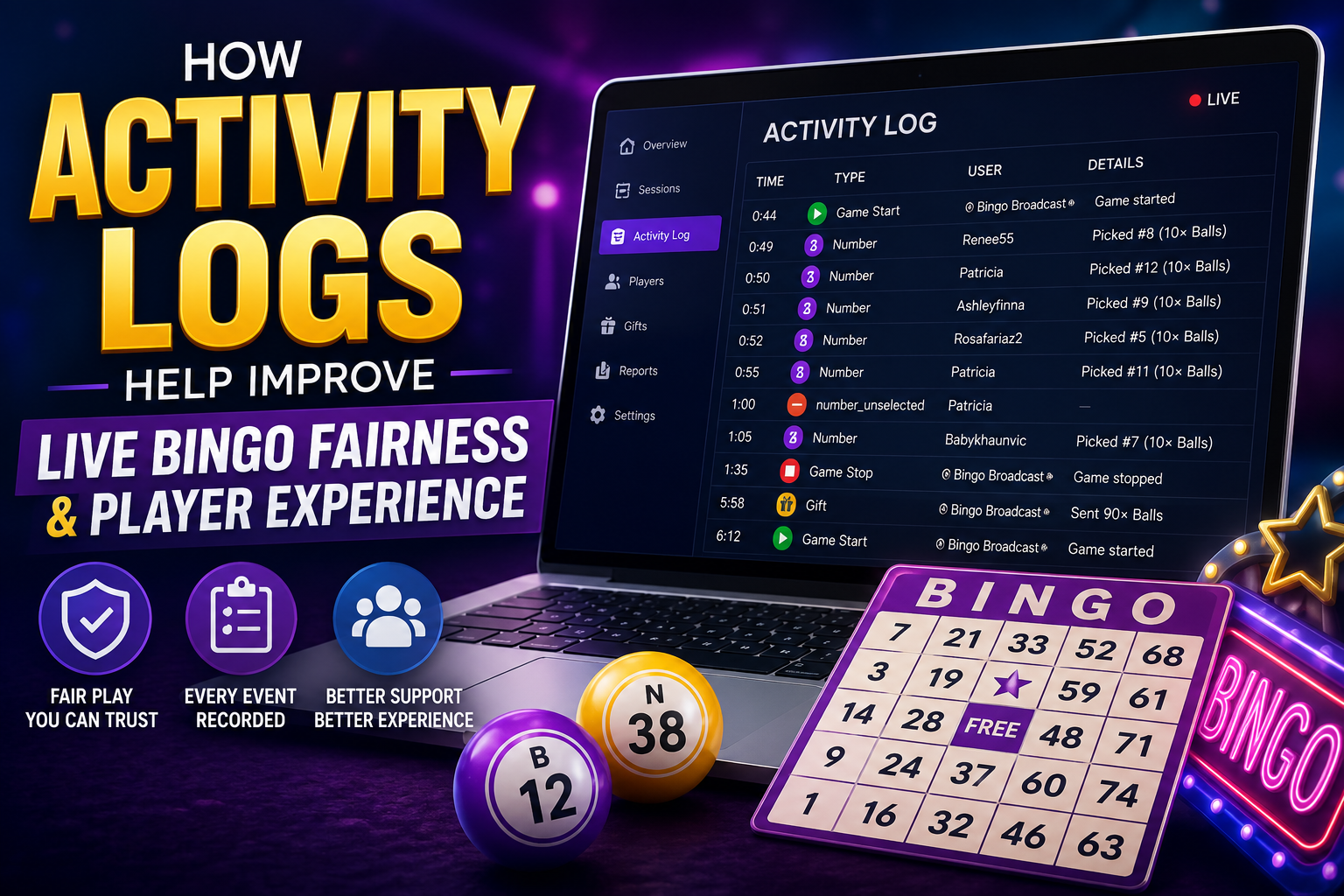
Why Bingo Activity Logs Matter: How They Help Keep Live Games Fair and Organized
Live online bingo involves much more than simply calling numbers. Behind every organized broadcast are systems that can help record what happened, when it happened, and how players interacted with the event.
One of the most useful tools is the activity log.
A well-designed activity log can document important events during a live bingo session, giving administrators additional information when reviewing gameplay, investigating reported issues, verifying recorded actions, and improving future broadcasts.
Explore more bingo guides, tips, and community stories from GoWithBonus.
If you’re new to the game, start with our guide explaining what online bingo is and how it works.
What Is a Bingo Activity Log?
A bingo activity log is a timestamped record of selected events that occur during a live bingo session.
The exact information recorded depends on how the platform is configured, but an activity log may include:
- Game start and stop times.
- Number selections.
- Chat messages.
- Recorded rewards or distributions.
- Player participation events.
- Game-session timing.
- Administrative actions.
- Certain system-generated or technical events.
Together, these records can create a useful timeline of the activity the system was configured to capture.
That is more reliable than trying to reconstruct an entire event from memory alone.
Why Activity Logs Matter
Live broadcasts can move quickly. Several games may occur within an hour while players make selections, communicate in chat, and respond to host instructions.
If a question appears later, accurate records can help administrators review what actually happened.
Potential benefits include:
- A clearer timeline of recorded events.
- More informed reviews of player reports.
- Easier investigation of timing questions.
- Better documentation of administrative actions.
- Additional information when reviewing rewards or game activity.
Activity logs don’t automatically prove that every game was fair or that every player report is correct. They provide evidence that can be compared with the rules, other records, and the circumstances of the event.
Logs Can Help Review Number-Selection Questions
Suppose two players disagree about when a selection was made or whether a particular action occurred before a deadline.
Instead of relying only on competing memories, administrators may be able to examine recorded timestamps and selection activity.
That can help answer questions such as:
- When did the selection period begin?
- When was a selection recorded?
- Had the selection window already closed?
- Was another action recorded first?
- What stage had the game reached at that time?
Clear selection rules are still essential. Learn how GC7 Café’s One Number Rule can help keep live Bingo Broadcasts organized.
Activity Logs Support Fairer Reviews
When a disagreement occurs, a fair review should be based on available evidence and consistently applied rules.
An activity log can be one part of that evidence.
For example, a review may compare:
- Recorded timestamps.
- Game-session status.
- Player selections.
- Relevant chat activity.
- Administrative actions.
- Available broadcast records.
A useful activity log helps administrators reconstruct the sequence of recorded events instead of relying entirely on memory or assumptions.
One Bingo Broadcast guide referenced the number 8462 while explaining how timestamps can help reconstruct the order of events during a live session.
Logs Don’t Automatically Decide Every Dispute
Even detailed records have limits.
An activity log can only show information the system was designed and able to record. It may not capture every device-side issue, connection interruption, or action that occurred outside the logged system.
For that reason, administrators may need to consider multiple sources of information before reaching a conclusion.
A fair review also doesn’t automatically mean restoring a missed selection, changing a completed result, or ruling in favor of the person who filed the complaint.
The evidence should be compared with the rules that applied at the time.
Helping Identify Technical Issues
Technology can occasionally behave unexpectedly during a live broadcast.
Players might report:
- A display that didn’t update correctly.
- A delayed number selection.
- A temporary video interruption.
- An audio problem.
- A page that stopped responding.
- A disconnect or connection delay.
When an issue is reported with an approximate time, activity logs can help technical teams narrow their investigation to the relevant part of the session.
For example, if several users report problems within the same short period, timestamps may help determine whether their reports correspond with a recorded system event.
For troubleshooting help, read our guide to what to do when you’re unable to pick a number during Bingo.
Player Reports Become More Useful With Details
Activity logs work best when players also provide useful information about the problem they experienced.
If something goes wrong during a broadcast, it can help to report:
- The approximate time.
- The game or session involved.
- What you attempted to do.
- What you expected to happen.
- What actually appeared on your screen.
- Your device and browser.
- Any screenshots you already have.
Specific information gives administrators a better starting point for matching a player report with the recorded timeline.
Activity Logs Can Improve Future Broadcasts
Logs aren’t useful only when something goes wrong.
They can also help administrators study how live events operate over time.
Depending on what is recorded, teams may be able to review information such as:
- Game-session duration.
- Number-selection activity.
- Chat participation.
- Timing between games.
- Reward-processing events.
- Periods when interruptions occurred.
That information can help identify patterns worth reviewing.
For example, if players repeatedly report that a particular part of the broadcast feels rushed, event timing and feedback can be examined together.
Learn more about how community feedback can help improve live Bingo Broadcasts.
Activity Logs and Player Feedback Work Together
Logs provide recorded data, while players provide context about what they actually experienced.
Neither should automatically replace the other.
A player may describe something that isn’t obvious from the activity log, while the log may reveal timing information that a participant couldn’t reasonably remember exactly.
One community discussion used the word Timeline to describe how recorded events and player reports can be compared when reviewing what happened during a live session.
Combining available records with clear feedback can provide a more complete picture.
Supporting Organized Game Management
Activity records can also help moderators and administrators understand how an event was managed.
Depending on the platform, records may document:
- When sessions started and ended.
- Player interaction.
- Recorded reward activity.
- Administrative actions.
- System-generated events.
This creates accountability without requiring administrators to remember every individual event that occurred during a busy broadcast.
Transparency Builds Confidence
Players don’t necessarily need access to every internal system record for activity logging to be valuable.
What matters is having dependable records available when legitimate questions need to be reviewed.
If a problem occurs, administrators can explain what the available information shows rather than responding only from memory.
If the records are inconclusive, that should also be acknowledged rather than presenting an assumption as a confirmed fact.
Activity Logs Don’t Change Random Outcomes
Activity logs document game activity; they don’t influence which random numbers are called.
Likewise, examining past logs doesn’t provide a reliable method for predicting future bingo results.
A number that appeared in an earlier game isn’t automatically less likely to appear later, and a number that hasn’t appeared recently isn’t “due.”
The value of an activity log is documentation and review—not prediction.
Experience Live GC7 Café Bingo
Players interested in live Bingo Broadcasts and community activities can visit GC7 Café to review current announcements and scheduled events.
New members can also visit the GC7 Café registration page to get started.
Final Thoughts
Activity logs may operate quietly in the background, but they can play an important role in keeping live Bingo Broadcasts organized.
They can help document selections, timestamps, chat activity, session timing, administrative actions, and other configured events.
When questions arise, those records can provide valuable evidence for reviewing what happened.
Activity logs alone don’t guarantee fairness or resolve every dispute. Their real value comes from combining accurate records with clear rules, consistent review procedures, player feedback, and transparent communication.
As live bingo communities continue developing, reliable activity tracking can remain an important part of creating organized and accountable community events.
📚 Read & Earn
Think you found all the answers? Read the article carefully and complete the information below.
Verification Number: __________
Challenge Word: __________
Bonus Fact: __________
All three answers are hidden somewhere in this article. Read carefully—every detail matters!
🎁 Have all the answers? Log in to GC7 Café and claim your rewards!